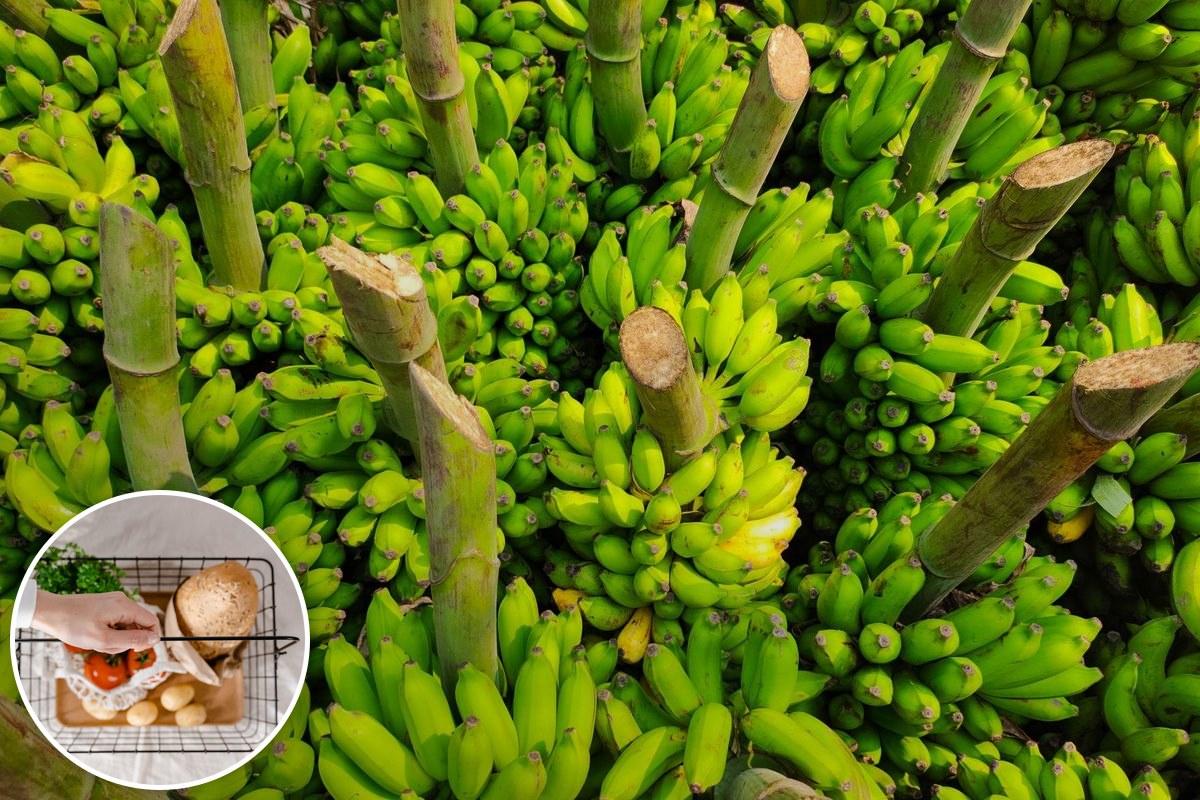
Panama disease tropical race 4 has spread to an 11th Queensland banana farm — and this time it belongs to the man who has been leading the industry's fight against it, the ABC reported. The latest incursion was detected on one of Leon Collins's farms south of Cairns. "Some days you think you're fighting a losing battle. It is really hard," the Tully farmer said. "It's heartbreaking, but it's just what we've got to live through."
TR4 is a soil-borne fungus that cannot be eradicated. Its spores live in the soil for decades, waiting to attack banana plants through their roots and eventually kill them. For more than a decade, growers along the Tully River have been living with the disease as it slowly spreads down the waterway — and it poses a particular risk to the Cavendish variety, which accounts for more than 97 per cent of the fruit produced in Australia, and much of the world's.
The man leading the fight is now in it
Collins chairs the Australian Banana Growers' Council, so the 11th detection means the man who had been leading the fight is now also in the trenches. "It's a fact of life and sometimes you get dealt the wrong cards," he said. So far the strict biosecurity measures adopted by Tully-region growers — an approach formalised in the Code of Practice for the management of Panama TR4 published by Queensland's Department of Primary Industries — appear to have contained TR4 to that district. "Innisfail [50km north] is our largest growing area now so we have to protect that and make sure we keep it free of disease," Collins said. His longer-term bet is elsewhere: "I believe our saviour is going to be plant breeding."
A GM banana with federal approval
The most advanced candidate already exists. In 2024, researchers at the Queensland University of Technology received federal government approval to commercialise the world's first genetically modified banana, developed specifically to resist TR4. Named QCAV-4, it looks and tastes the same as a Cavendish — the only difference is the added resistant gene. It was trialled in the Northern Territory, where Panama disease has been established since the 1990s, though no one is growing it commercially yet; researchers have hoped it could reach shelves by 2027. "Growers in the Tully Valley would love to see our bananas trialled more extensively so they can understand whether they're comparable to current varieties," said Anthony James of QUT's Centre for Agriculture and the Bioeconomy.
The harder sell may be shoppers. The Office of Gene Technology Regulator's most recent report on community attitudes, from 2024, found only 32 per cent of respondents were willing to eat GM fruit and vegetables. Dr James said QCAV-4 had undergone rigorous scientific and regulatory assessment, and that when it reached consumers they could be confident it was safe to eat.
The old-fashioned route
Others are backing conventional breeding. A project led by Naomi Abbott at North Queensland Banana Research is crossbreeding TR4-resistant lines in collaboration with FIA, a Honduran banana breeding program. "We've commenced plant breeders' rights on a few of our key lines … so we're expecting to have our first Cavendish line available by 2028," she said. The pipeline currently holds 30 to 40 hybrids, four of them under serious consideration. "In terms of Cavendish, there's two we're working with and one clear frontrunner."
Queensland's Department of Primary Industries is working towards resistant Cavendish varieties too, with help from overseas — but its results show why this is hard. Principal Horticulturalist Jeff Daniels said seven Cavendish lines had shown sufficient resistance, yet none produced enough fruit for the Australian industry. "They all have a yield penalty ranging from 60 to 90 per cent of the industry standard," he said. "We're not there yet and … additional investment is required to develop a better TR4-resistant Cavendish than we currently have available."
For growers still free of the disease, even an imperfect pipeline is something. Adrian Crema, a Tully banana farmer whose property has no TR4, said the threat is never far from his mind — but the breeding progress had buoyed him. "I was really, really happy to hear that the research is getting done and there's possibly some varieties coming on the horizon," he said. "To me, that was the most exciting thing I'd heard all year."