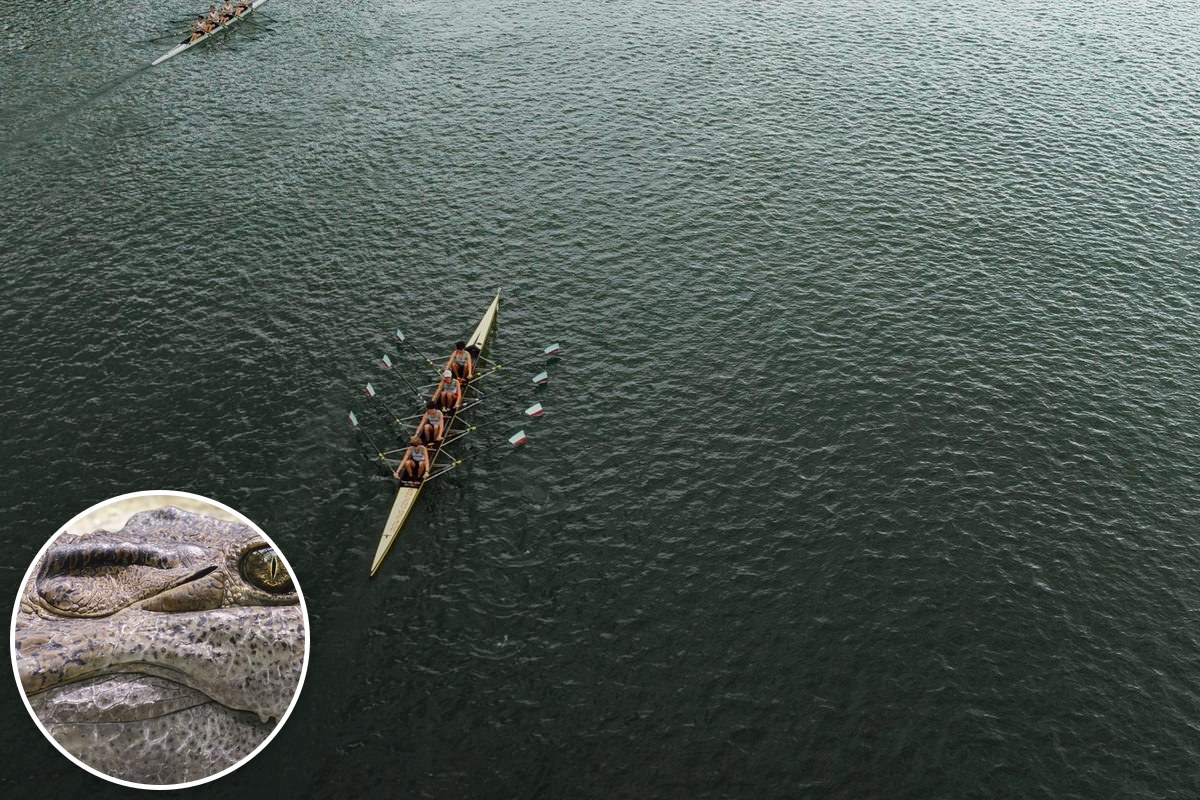
Olympic rowing on the Fitzroy River is officially happening. The International Olympic Committee this week signed off on Rockhampton's river hosting rowing and canoe sprint at the 2032 Brisbane Olympics, following an independent technical assessment endorsed by World Rowing and Paddle Worldwide — ending months of fierce debate over the river's suitability, including its status as crocodile habitat. The Queensland government says Rockhampton passed "with flying colours"; the assessment itself has not been released publicly, and the decision has drawn widespread international attention for one reason above all: the crocodiles.
So how many are there? The contested numbers tell the story. Queensland holds an estimated 20,000 to 30,000 estuarine crocodiles, and Rockhampton sits inside croc country — but with far fewer animals than the state's north. Department of Environment modelling from 2019 recorded about 0.2 crocodiles per kilometre around Rockhampton, a ratio that across the 480-kilometre Fitzroy implies roughly 96 animals in the entire river. Reports had claimed 500; Koorana Crocodile Farm owner John Lever, who has caught, bred and sold crocodiles from his central Queensland farm since 1981, puts the real figure at "about 50". The Olympic course, for the record, is two kilometres long.
Mr Lever thinks the whole controversy is a media beat-up. "I would be more concerned about having a vehicle accident on the way to put your boat in than I would about the crocodiles," he said. "There's very few crocodiles in the freshwater section of the river — I think we've had four removed in 40 years — so there's no great threat there. School kids are out there rowing every day of the week and if it was considered to be a danger, they wouldn't allow those school kids out there." A department spokesperson backs the record: there has never been a documented negative interaction between humans and crocodiles in the Rockhampton region — though a four-metre animal was spotted in a popular water sports stretch of the river as recently as 2023.
Not every expert is relaxed. University of Queensland crocodile researcher Emeritus Professor Craig Franklin called it a "foolish and misguided decision" to host the event in croc country. "Simply, it is not OK to canoe or row where estuarine crocodiles live and breed," he said. "It is dangerous, and the consequences can be lethal."
The technical case rests on the river itself. The assessment — by the Games Independent Infrastructure and Coordination Authority and Dutch marine engineers WaterProof — tested flows, water levels, wind and waves, and the government says it confirmed a full-length international flatwater course is possible. World Rowing president Jean-Christophe Rolland said the results showed the river could deliver "fair competition conditions", and the official endorsement had Premier David Crisafulli — who days earlier dismissed critics as "naysayers" having a "last hurrah" — declaring the doubters proven wrong. Deputy Premier Jarrod Bleijie credits the 1970-built barrage, which splits the river into salt and fresh sections, as "Rockhampton's secret weapon" for creating a mid-river racing dam.
Queensland Row Union president Gary Merritt still has concerns beyond teeth: with the barrage closed and no rain there is no current at all, "but if there is a rain event anywhere in that catchment, which is three and a half times the size of the Netherlands, then that can affect flow in the different lanes". The next review phase covers the banks — grandstands and a boating park that Mr Merritt warns carry "a very strong risk that the course will be washed away in a flood". Accommodation is the other gap: the region's peak tourism body has flagged the need for an extra 1,200 short-term rooms by 2032, and its chief executive Mary Carroll says investor discussions are underway and she is now "confident" of getting there.
Meanwhile, the river is not waiting for 2032. Up to 800 athletes contest the Rowing Queensland Schools' Championship Regatta on the Fitzroy this weekend, north of the barrage — under a safety management plan that acknowledges the neighbours. If one is sighted, a call of "crocodile, crocodile, crocodile" goes out, and racing is suspended until the risk has been assessed.