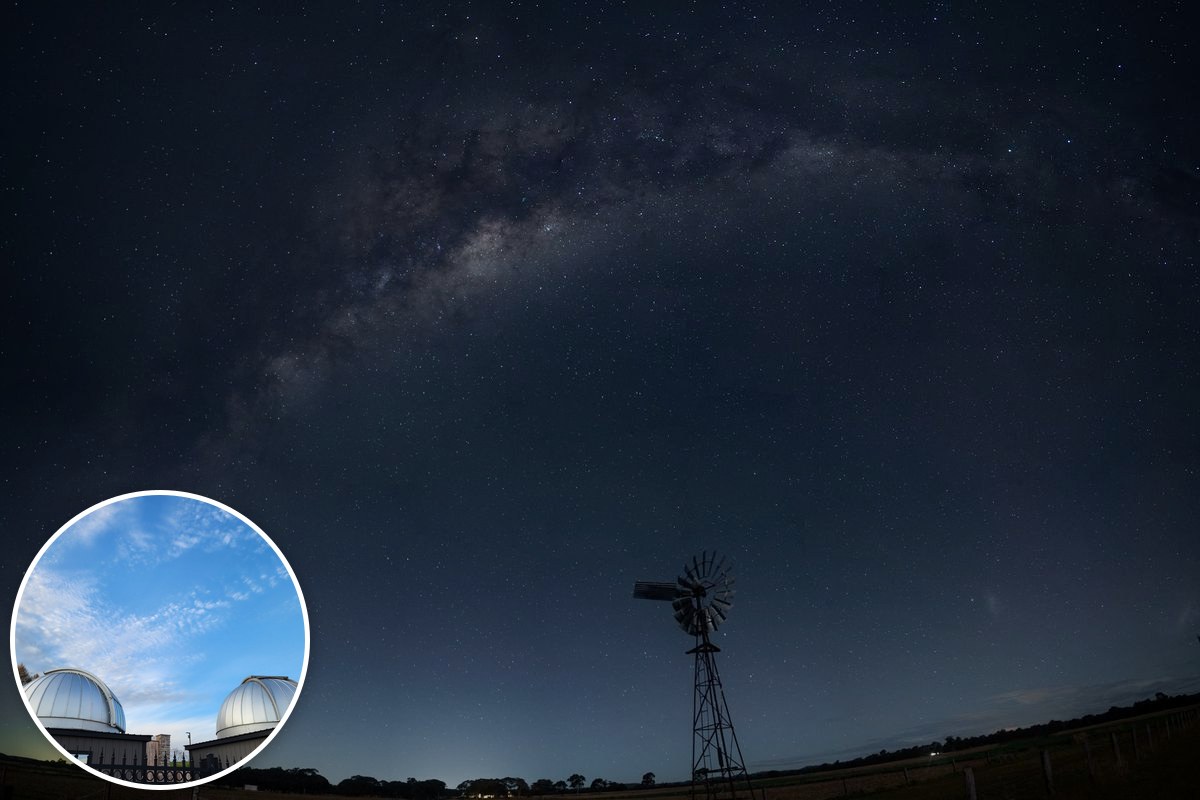
Orbs of light streaking across the night sky below Venus have been fascinating Queensland sky watchers, appearing at about 8pm to the west and sparking online debate that has ranged from aliens to min min lights to defence testing. Now an unlikely partnership has produced an answer, reported by the ABC on Saturday: satellites.
Lisa Manteit has watched them from her house in Marian, west of Mackay. She thought they were drones at first, until she saw people across Australia posting about them online. "I see all these, what look like moving stars, but they sort of swirl around and go in circles and some of them have colour," she said.
Graham Moyle and others in a Central Queensland astronomy group set out this month to test the theories, and found evidence the lights may be caused by clusters of moving satellites. That "may" is doing honest work — but the case has since been backed by experts. "When you do see them, when you watch them, they do look sort of freaky," Moyle said. "Because they just appear out of nowhere and then they silently travel through near Venus and then disappear again."
The engineer checking the maths from California
The group's most unexpected ally is Philip Giacalone, a retired ex-NASA aerospace engineer based in California, who has been verifying the sightings against real-time orbital data. He describes the lights as a worldwide phenomenon that occurs when satellites move in line with the Sun below the horizon — no alignment with Venus required. "Satellites are going overhead in low-Earth orbit, which is reflecting the sunlight off the bottom of the satellites," he said.
Giacalone has built a free program, Curious Pilot, that tracks when these flares will be visible from any location in the world — a tool he expects to become more necessary as satellite launches increase sharply. "That's going to make this problem bigger and bigger, and people are going to be confused," he said. "I'm just trying to help to eliminate some of that confusion."
16,000 active satellites, and counting
The numbers behind the confusion are striking on their own. University of Southern Queensland astrophysicist Jonti Horner says the number of objects in space has tripled since 2020. "We now have more than 16,000 active satellites orbiting Earth and more than 34,000 additional bits of dead satellite and other space junk that we're tracking orbiting the Earth," Professor Horner said. About 10,000 of those active satellites are Starlink, and the ABC's report notes SpaceX CEO Elon Musk has shared plans to put a million more into orbit.
Horner is not arguing the sky should be emptied — he points to obvious benefits, including better internet and accurate GPS. His concern is the pace. "It's all a little bit feral and unregulated at the minute," he said. "The more of them we have up there, the brighter the sky will be, which will make it harder over the years to come to see the Milky Way, things like that."
The Australian Space Agency said in a statement it was placing "greater emphasis" on safe and sustainable use of space, that Australian civil space activities are regulated to include debris mitigation, and that it is continuing to make reforms.
Not everyone is convinced
The satellite explanation has not landed with everyone who has actually watched the lights. Manteit says she has seen movements that did not match the straight trajectory of a satellite. "I really, really can't explain them," she said. It is a fair note of dissent to leave standing: the astronomy group's own finding is that the lights may be satellite clusters, and the verification work is ongoing rather than closed.
For anyone who wants to check for themselves, the lights have been appearing at about 8pm, low to the west and below Venus — and Curious Pilot will simulate what satellites should be flaring over any location you give it, up to a few evenings ahead. Either you will catch a flare where the orbital data says one should be, or you will have something genuinely unexplained to report.