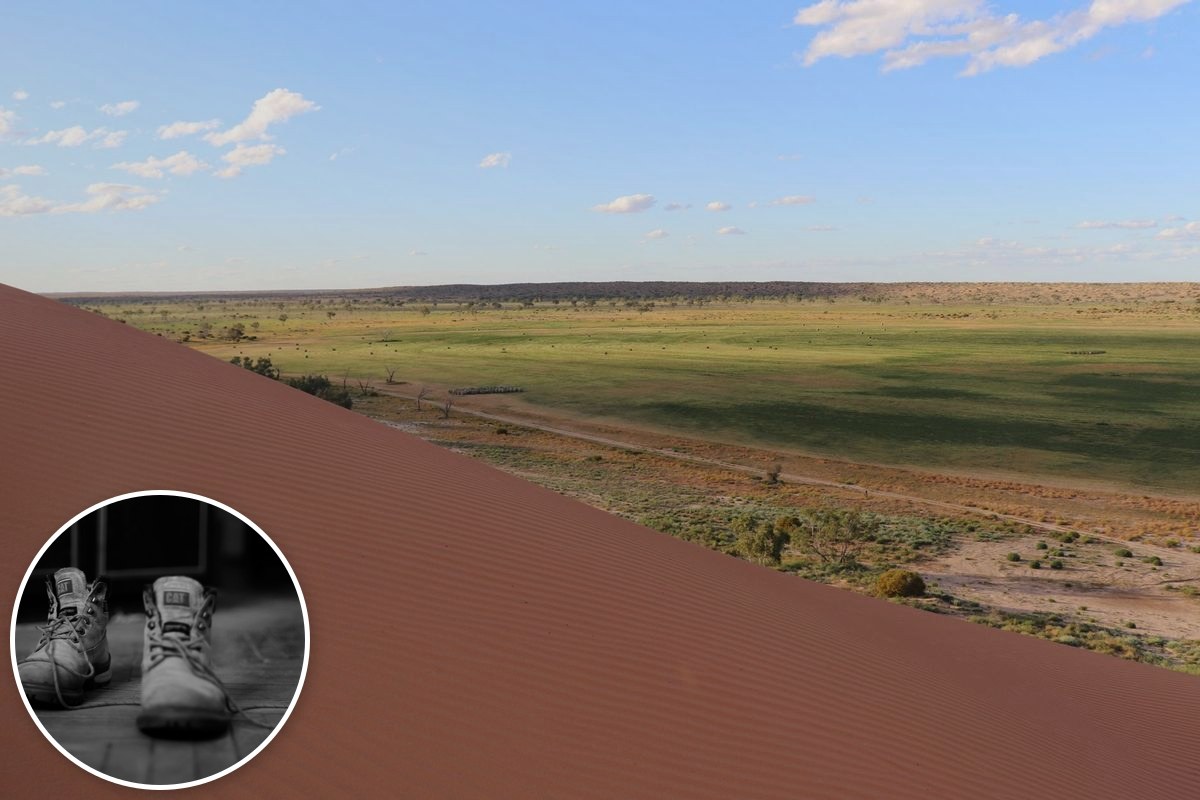
For most people the Simpson Desert is a bucket-list wilderness to pass through. For Don Rowlands it is home — the traditional lands of the Wangkangurru Yarluyandi people, who know the big sandhill country as Munga-Thirri. For more than three decades he has been the ranger in charge of Munga-Thirri National Park, Queensland's largest protected area, near Birdsville in the state's far south-west — and now, as the ABC reported on Sunday, he is retiring.
"The uniform was why I get up in the morning. I'm so proud of the uniform and what it represents to Queensland; it's the ultimate for me," he said. He has put it on every day for the past 32 years. "No matter where the path takes me, I will always be walking in the desert."
The first ranger of Munga-Thirri
Queensland's slice of the Simpson Desert's million hectares of sand dunes — this year awash with floodwater and wildflowers — was gazetted as a national park in 1967. But it was not until 1994 that Don Rowlands became the first Queensland Parks and Wildlife ranger employed to care for it, and he set about reshaping what the job meant: a daily balance of conservation, visitor access and preserving culture.
He pushed for the park to carry its traditional name, and became a leading advocate for native title recognition — a fight that ran two decades and culminated in a determination in 2014. The advocacy meant navigating ground he knew well. "Most of my mob were so entrenched with growing up with white people that they didn't want to upset them," he said.
That knowledge was hard won. Rowlands grew up in Birdsville as a ward of the state, his early life dictated by government authorities and police. "That hurt as kids and we realised that we had another boss, someone else who had control of our lives and that took a bit for us to adjust," he said. Which is part of what the uniform came to mean: "It's given me the freedom to talk about my heritage, to talk about my people in the desert." His wife of 52 years, Lyn Rowlands, put it in one line: "I was really proud of him to be wearing that uniform … that he had a job in government after the way he was treated."
What the desert lost and kept
The desert he hands over is not the one he grew up in. Much of the bush tucker he found as a kid is gone, the birds have thinned out, and feral cats continue to wreak havoc. Early on the problem was millions of rabbits: "When the calicivirus came along in 1996 and wiped them out that was a big thing for me," he said. Alongside the ecology he has followed and researched his people's songlines — the pathways connecting places, people and stories across the dunes.
He can distinguish every dune, and that map in his head has been operational as much as cultural. He has been involved in dozens of rescues, many alongside Stephan Pursell, who was Birdsville's police officer for almost a decade. "Without Don, the rescues and just general travel would have been near impossible for me," Pursell said. "I don't think he's replaceable to be honest."
The town feels the same. At the Birdsville Hotel, Ben Fullagher said the retirement leaves a huge gap: "We call on Don usually around conditions in the desert, what the creeks are doing, what the floodwaters over the summer might be doing. It's a very important part of the local economy, ensuring access is open and regular for the tourism across the desert."
Rowlands — who spent much of his earlier life in the saddle as a ringer in mustering camps, and holds an Order of Australia Medal for his services to the community and the environment — is not framing retirement as an ending. "Despite having to move on, my heart is still in the desert and it's my traditional lands and I have a responsibility to care for it and I will," he said.
His stated aim now is continuity. "That's one of my aims, to make sure my family don't disappear off the map," he said. "It's all about preserving our story … it's really important that I leave my message here for my kids."