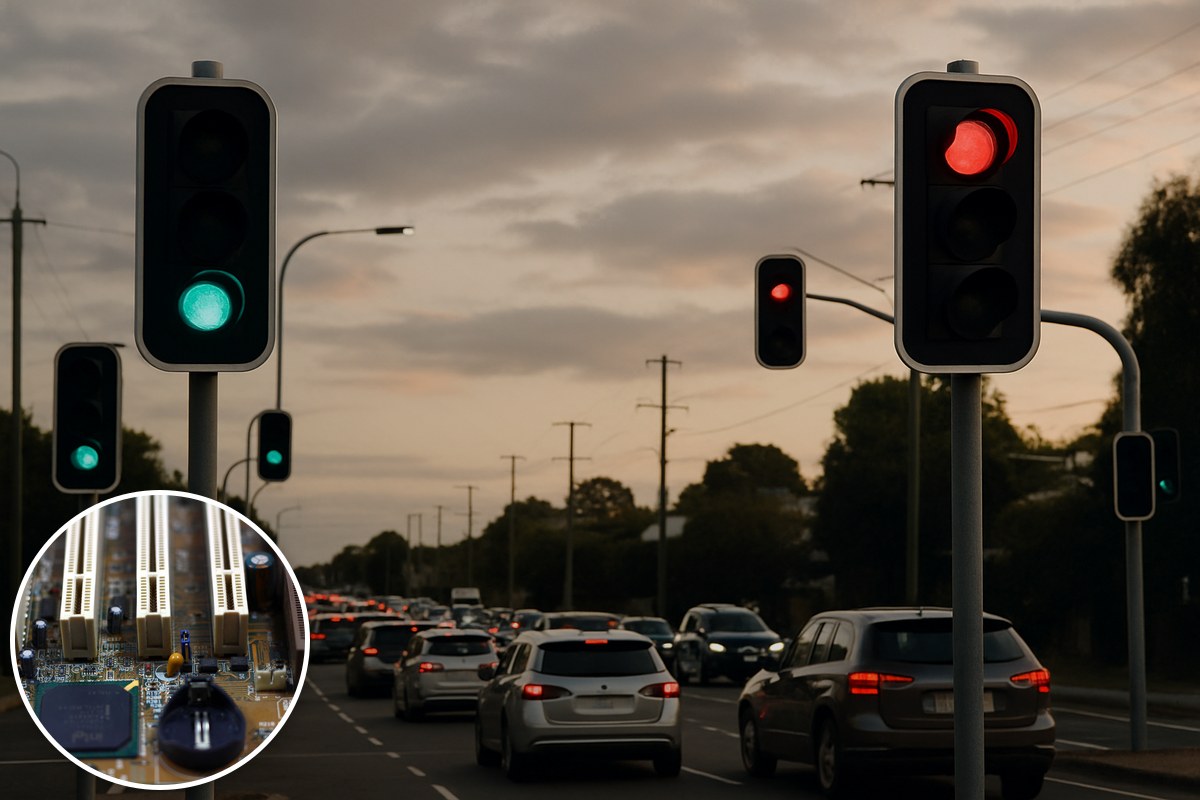
Two of Brisbane's busiest road corridors will have their traffic lights managed with the help of artificial intelligence from early next year, under a $15 million Brisbane City Council trial the council says is the first of its kind in Australia. The technology will be installed at 22 intersections on Logan Road and 15 on the Kelvin Grove Road corridor — 37 in all — replacing the phase-based signal system that has been commonplace on Australian roads since the 1950s.
Council transport chair Ryan Murphy said the system would sit on the existing infrastructure "like a top hat", with cameras able to identify pedestrians, cyclists, cars, trucks and public transport, then use traffic volumes and queue lengths to calculate the best light sequence. "The system will learn over time and will be able to suggest different interventions to the operators," he said. "It will give us the ability to truly manage our transport network rather than just observe it. This is not just about optimising flow for cars, but it is about public transport, active transport and freight."
For anyone uneasy about cameras deciding when they cross the road, Cr Murphy said there would always be "a human in the loop", and that all data collected would stay in the city. "Faces are blurred, number plates are blurred and no data will be sent off shore," he said. The system can also adapt to weather conditions and major events, like football games — and the council, not the algorithm, will decide the rule set: some corridors may be optimised for pedestrians, such as in the CBD, and others for freight during the day.
The council says the technology, already rolled out in other major cities worldwide, could cut average travel times by up to 15 per cent and reduce rear-end crashes by 12 per cent — projections that will be tested when the six-month trial begins early in 2027. Work to build the software and integrate it with the current system starts in the coming weeks, and at the trial's end the council will decide whether to roll the technology out across its full network of 1,000 signalled intersections. National motoring press has already picked up the trial as one that could herald a big change to Australian roads if it succeeds.
Brisbane is not the first corner of the region to experiment. The City of Moreton Bay announced its own trial in August — a $170,000 pilot at a single, deliberately low-traffic intersection at Petrie, running until early 2029 on a system by Austrian company SWARCO. The technology's overseas record is what makes traffic engineers take notice: in Pittsburgh, an AI-based system developed by Carnegie Mellon University researchers was found in 2019 to have cut average travel times by 25 per cent, with cars spending up to 40 per cent less time idling.
The RACQ's public policy executive manager Michael Kane welcomed the move, saying it was important to look beyond a single intersection and two roads to the whole network. "What we think is really important is how this technology can continue to be with us for a long time," he said. Labor's council Opposition leader Jared Cassidy was cooler, noting the announcement came two years after the council first said it would explore the technology. "This isn't the solution to Brisbane's congestion problem but hopefully it makes some small difference," he said.
The trial also lands weeks after the council showed the other side of its AI thinking, banning AI smart glasses from secretly filming people at its 21 public pools. Lord Mayor Adrian Schrinner said the pairing showed the council understood the technology could be used for good or "evil". "This is using it for a good purpose, this is using it to get traffic flowing, to improve safety [and] prioritise public transport," he said.